

From recycled carbon fibres and thermoplastic composites to multimodal sensing and hybrid manufacturing, the research presented at the 2026 SAMPE UK & Ireland Student Seminar Competition demonstrated just how broad the future of advanced materials and processing is becoming.
Held on 7 July at the University of Nottingham’s Advanced Manufacturing Building, the competition brought together postgraduate researchers from universities across the UK to present their work to a panel of experienced SAMPE members.
The Student Seminar Competition has been part of SAMPE’s international activities for more than 40 years, created to encourage technical excellence, give emerging engineers and researchers an opportunity to present their work, and help build connections across the advanced materials community.
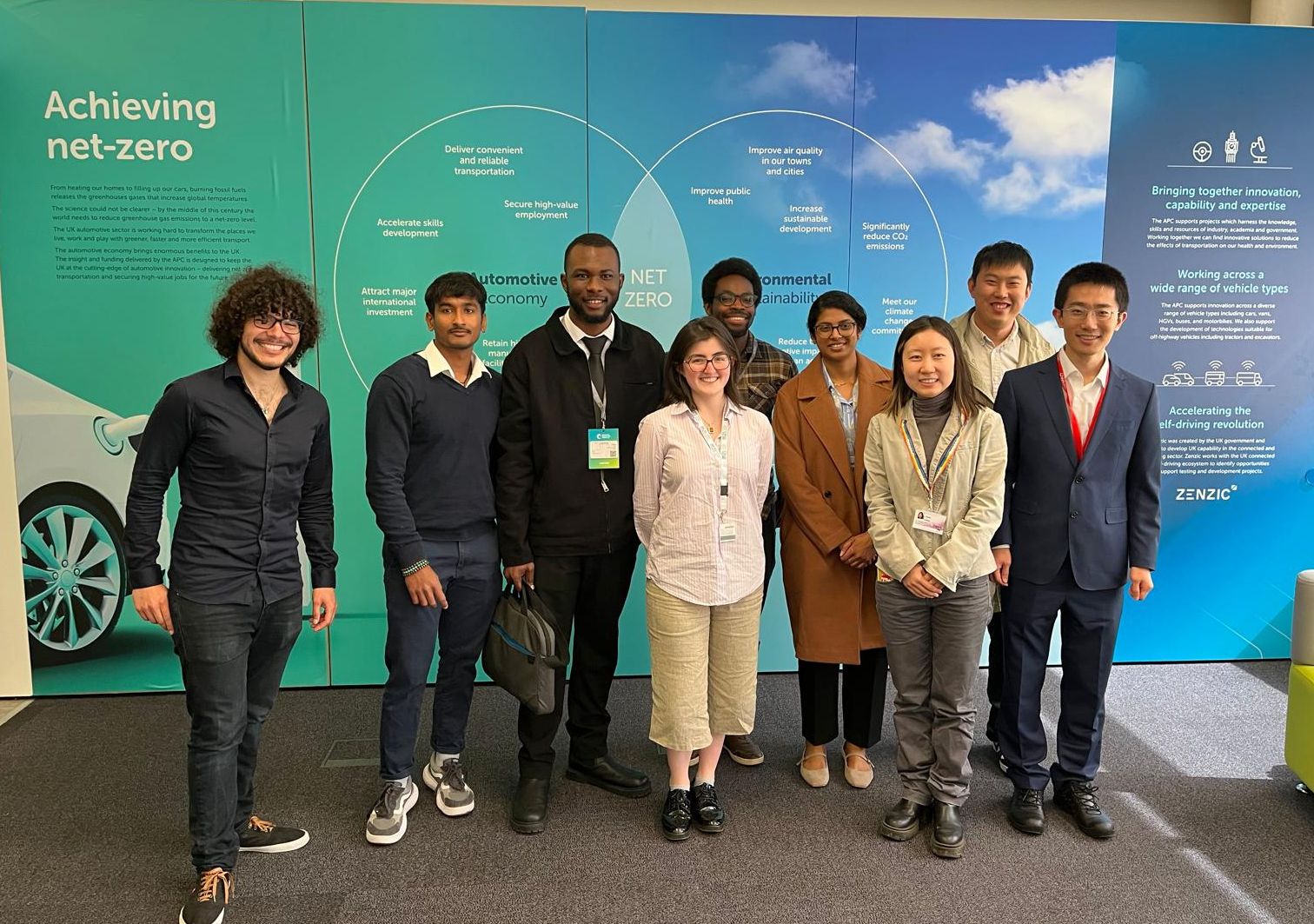
This year’s UK & Ireland competition attracted a strong field, with eight students presenting research spanning manufacturing, modelling, recycling, thermoplastics, sensing and composite performance.
The participants were:
- Monika Lingemann, University of Nottingham, presenting “Demanufacturing with Debondable Primers – Understanding Microsphere Expansion”
- Aysema Unlu, University of Bristol, presenting “Studying the Influence of Consolidation Temperature on Co-Aligned PA46/Carbon Discontinuous Thermoplastic Composites Manufactured via the HiPerDif Method”
- Yansong Li, University of Warwick, presenting “Interference-Free Multimodal Sensing for Continuous Biophysical Mapping”
- Monis Luqman Mohammed, University of Exeter, presenting “Understanding the LMPAEK’s Crystallisation-Mechanical Performance Relationship Through Thermal Fractionation”
- Hossein Veisi, University of Manchester, presenting “A New Manufacturing Method for Continuous Yarns Made from Recycled Carbon Fibres”
- Zikang Shi, University of Manchester, presenting “3D Compaction Printing in Carbon Fibre Reinforced Thermoplastics with Transient Thermal Modeling”
- Yongxue Chen, University of Manchester, presenting “Can Any Model be Fabricated? Inverse Operation Based Planning for Hybrid Additive-Subtractive Manufacturing”
- Joseph Humphries, University of Nottingham, presenting “Cantilever Bending of Tapered 2D and 3D Woven Carbon Fibre Composites: An Experimental and Computational Investigation”
Each student delivered a 15-minute presentation followed by questions from the judging panel, with presentations assessed on technical content, presentation technique, delivery and overall engagement.
The judging panel, comprising Lee Harper, Andrew Mills and Carwyn Ward, highlighted the consistently high standard across the competition, both in the quality of the research and the confidence with which it was presented.
Perhaps most encouraging was the maturity of the projects. Many of the students were presenting research that was already well established and technically developed, reflecting the strength of advanced materials research taking place across UK universities. The diversity of the subjects was equally striking.
Composite research is no longer confined to improving a single material property or manufacturing process. The projects presented explored questions around recyclability, manufacturing efficiency, thermal behaviour, digital manufacturing, structural performance and sensing, demonstrating how the field continues to expand into new technologies and applications.
As the judging panel reflected following the presentations, the future of composites appears to be in good hands. Two researchers were selected to represent the SAMPE UK & Ireland Chapter at the SAMPE Europe Technical Conference in Lecce, Italy.
Zikang Shi of the University of Manchester was selected for his work on “3D Compaction Printing in Carbon Fibre Reinforced Thermoplastics with Transient Thermal Modeling”, while Monis Luqman Mohammed of the University of Exeter was selected for his research into the relationship between crystallisation and mechanical performance in LMPAEK materials.
Yansong Li of the University of Warwick was recognised in third place and will act as reserve representative should either winner be unable to attend.
In Lecce, Zikang and Monis will compete against researchers representing other European SAMPE chapters. The eventual European winner will have the opportunity to represent SAMPE Europe in North America the following year.
There is a strong history behind that pathway. The UK & Ireland Chapter has produced six European Student Seminar winners to date, most recently Bruno Pereira Santos of Imperial College London in 2025.
But the value of the competition extends beyond the final result. Every student who participated receives one year of SAMPE membership, giving them access to a wider network of researchers, engineers and advanced materials professionals. The Chapter is also arranging an industrial visit for the participants, providing another opportunity to connect academic research with industrial practice.
That connection is an important part of what professional communities such as SAMPE can offer emerging engineers.
Research develops within universities, but its eventual value often depends on the conversations that happen beyond them. Opportunities to present technical work to industry, answer challenging questions, meet researchers from other institutions and understand how different organisations approach materials and manufacturing can all influence how a young engineer develops.
The Student Seminar Competition creates one of those opportunities.
The research may be diverse, but the common thread is clear: a new generation of engineers is already working on many of the challenges that will shape the future of composites. The next step is making sure they have the platforms, networks and opportunities to take that work further.