

Now that it’s been nearly three months since SAMPE UK & Ireland’s last Annual Seminar, now feels like a good moment to reflect on the event and how its presentations have manifested in the composites sector since.
The event brought together researchers, manufacturers and technology developers to examine one of the biggest challenges facing the composites industry: how to move advanced materials from laboratory innovation to reliable, scalable industrial production.
Held under the theme Advanced Materials & Manufacturing: From Microstructures to Megastructures, the programme reflected an industry increasingly focused on manufacturing readiness, digitalisation and sustainability, while continuing to push the boundaries of composite materials science.
A significant trend we’re seeing in composites is the ramping up of interest in next-generation aerospace programmes from Airbus and Boeing, with the aerospace supply chain bracing for renewed industry activity. The ATI published its Composites Framework for Growth to outline the “size of the prize” and the actions to strengthen UK manufacturing businesses, and the AMRC opened their COMPASS facility to support, among other things, Boeing’s development of high-rate production technologies.
There are clear links between our Seminar’s programme day-long programme and these macro-level trends. Digitalisation for productivity (see Boeing’s Project DELTA later in this article), tooling developments to support rate (see ALPEX’s presentation) and transformations in the UK’s supply chain for high-temperature materials (see HTMS’s fascinating talk).
Manufacturing is becoming a competitive advantage
Focusing again on the seminar itself, one of the strongest messages was that the conversation has shifted.
For many years, the composites industry focused on proving that advanced materials could outperform metals. Today, that argument has largely been won. The challenge now is to produce composite structures faster, more consistently, and at significantly higher production rates.
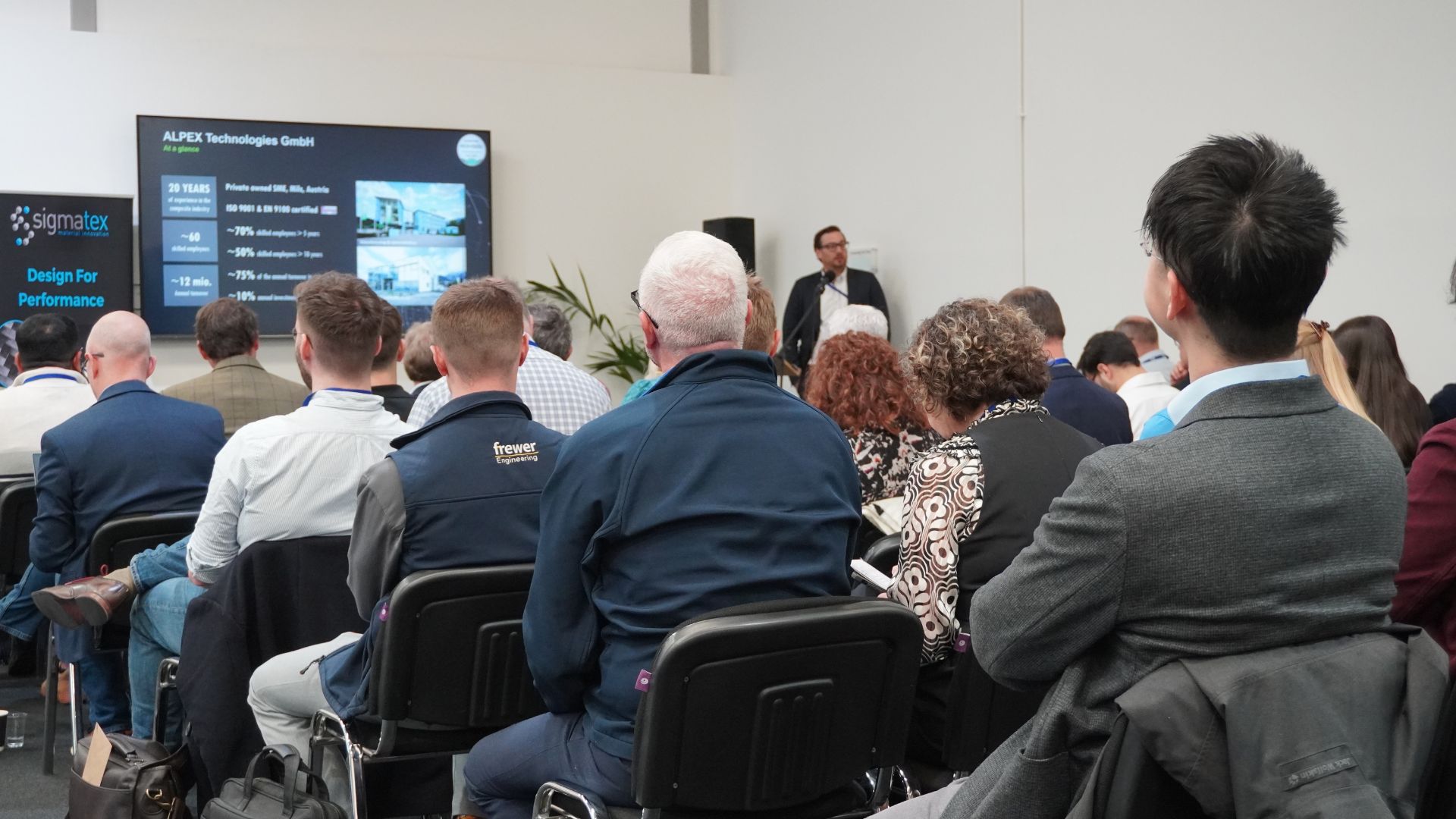
David Kampenhuber from ALPEX Technologies demonstrated how tooling systems are evolving to support industrial-scale composite manufacture. Closed mould processing, integrated heating and injection systems, intelligent process monitoring and digital process control are no longer viewed as future concepts, but practical technologies required to meet aerospace production rates. The emphasis throughout was on reducing manufacturing steps, shortening cycle times and improving repeatability while embedding sustainability into the manufacturing process itself.
Similarly, Boeing’s pioneering Project DELTA highlighted how manufacturing efficiency increasingly depends on the digital thread rather than individual machines. Their work demonstrated how Model-Based Definition (MBD), Digital Passports, connected factories and flexible robotic assembly can create continuous data flow throughout the supply chain, improving traceability while enabling more adaptable manufacturing systems. Particularly interesting was the acknowledgement that achieving this requires industry-wide standardisation, with compatibility between digital platforms remaining a major challenge.
Taken together, these presentations reinforced that future competitiveness will depend as much on manufacturing systems and digital infrastructure as on material performance.
Materials innovation continues at a pace
While manufacturing dominated much of the discussion, material innovation remains a focus for SAMPE’s specific attention.
Several presentations explored entirely new material systems designed to solve emerging engineering challenges.
HTMS introduced its Inorganic Matrix Composite (IMC) technology, positioning it between traditional polymer composites in often ambient operating environments and ceramic matrix composites at extremely high temperatures. This class of material offers higher operating temperatures beyond 500°C while aiming to overcome many of the cost barriers traditionally associated with CMCs. Of particular interest were applications in electric-vehicle battery protection and thermal management, where lightweight, fire-resistant structures are required.
Elsewhere, the University of Bristol presented research investigating metallic Z-pins embedded within composite battery enclosures. The modelling work demonstrated that introducing metallic Z-pins can improve through-thickness heat transfer, reducing battery temperatures while maintaining the weight advantages of composite structures. Although still at the feasibility stage, the research illustrates how composite structures are increasingly expected to perform multiple functions beyond simply carrying load.
These presentations reflected a wider trend towards multifunctional composites that combine structural performance with thermal management, safety and integration.
Better understanding materials remains essential
Despite the focus on industrialisation, fundamental materials science continues to underpin future advances.
Imperial College London presented research into arresting unstable compressive cracks using local ply discontinuities. By modifying the laminate architecture rather than introducing new materials, the researchers demonstrated significant improvements in crack-arrest behaviour while maintaining manufacturability and recyclability, and negating some concerns around certification for heavily regulated sectors. The concept illustrates how relatively simple changes to laminate design may improve damage tolerance in future composite structures.
Alongside this were presentations examining thermoplastic optimisation, carbon fibre supply resilience, crystallinity mapping, prepreg tack for automated fibre placement and automated surface preparation, highlighting the breadth of ongoing research supporting future manufacturing capability.
Digitalisation is no longer optional
Experienced engineering leaders have long known that digitalisation is inseparable from advanced manufacturing, but our Seminar programme demonstrated this ever more clearly.
Whether discussing automated inspection, connected factories, digital twins, flexible assembly or intelligent tooling, almost every session incorporated digital technologies as an integral part of future production rather than an additional capability.
The industry’s ambitions for higher production rates cannot be achieved simply by purchasing faster equipment. They require connected data, standardised information, intelligent process control, and closed-loop manufacturing systems capable of learning and continuously improving.
Looking ahead
SAMPE UK & Ireland once again demonstrated its ability to bring together industry, academia and technology developers to share ideas across the full composites ecosystem.
The seminar successfully balanced long-term research with practical industrial applications, highlighting innovations that range from fundamental material behaviour to fully connected digital factories.
Perhaps most encouraging was the sense that the UK composites community can tackle its next generation of challenges collaboratively through events and networks like those facilitated by SAMPE – the emphasis three months ago was clearly on translating innovation into industrial capability.
If previous years focused on demonstrating what composites can achieve, this year’s seminar showed an industry increasingly focused on delivering those capabilities at the scale, speed and consistency required by future aerospace, automotive and energy programmes.